Your Money Knows You Better Than You Know Your Self
Why your bank statement is your most honest mirror
Most people say they value freedom, family, health, meaning, and presence, but their bank statements suggest otherwise.
This isn’t a judgment. It’s an invitation. Because the gap between what we claim to value and where our money actually flows isn’t just about budgeting better or having more discipline. It’s about something deeper: the stories we tell ourselves versus the truth our energy knows.
Money doesn’t lie. It can’t. It’s pure energy in motion, and energy always reveals what’s real.
Before we go further, we need to get clear on something: values aren’t aspirations.
They’re not the qualities you admire in others or wish you embodied more fully. They’re not items from a workshop handout that sound noble and important. Values are the principles you consistently organize your life around, especially when things are inconvenient, costly, or uncomfortable.
Values show up in what you defend when it’s easier to stay quiet, what you make time for even when life is overwhelming, what you spend money on without much internal debate, and what you protect when something has to give.
This is why discovering your values is less about brainstorming words and more about paying attention to what’s already there. Your life is telling you what you value. The question is whether you’re listening.
Many of us inherited our values–from family systems, cultural conditioning, religious frameworks, achievement paradigms–without ever pausing to ask if they’re actually ours. We confuse programming with preference. We mistake what we were taught to believe with what we genuinely care about.
Part of living an Authentic Life is slowing down enough to ask, “Are these values actually mine? And if they are, can I see them in how I live?”
Here’s what happens when your money and your values drift apart: your energy fragments.
Think about it. You say family matters most, but you’re financing a lifestyle that requires constant work and keeps you perpetually unavailable. You say health is a priority, but it’s consistently the first thing sacrificed when life gets full. You claim to value presence, yet most of your spending goes toward distractions, numbing, or signaling status to people who don’t actually matter to you.
That’s not a budgeting problem. That’s an energy problem.
When your money flows in directions that don’t align with your deepest values, you create internal friction. Part of you knows the truth–even if you’re not consciously aware of it. That friction shows up as anxiety about money, even when you have enough. As resentment toward spending. As a vague sense that something is off, even when everything looks fine on paper.
Misalignment doesn’t usually happen because people are careless or irresponsible. It happens because life moves fast, defaults take over, and spending becomes reactive instead of reflective.
We spend to cope with stress.
We spend to signal belonging.
We spend to avoid confronting what we’re really feeling.
We spend because everyone around us is spending, and opting out feels too hard.
None of that makes you weak. It makes you human, navigating a system designed to keep you unconscious about money.
But here’s what most people miss: that friction isn’t just discomfort. It’s intelligence. It’s your deeper self trying to get your attention—not to judge you, but to invite you into greater alignment.
Your body knows the difference between aligned and misaligned spending before your mind admits it.
Think about the last time you made a purchase that didn’t sit right. Maybe you justified it beforehand. Maybe you explained it to yourself or your partner. Maybe you convinced yourself it was fine. But somewhere in your chest, there was a contraction. A tightness. A subtle sense of off.
That’s not guilt about the amount. That’s your energy recognizing a break in coherence.
Misaligned spending feels like a slight contraction when you swipe the card, even if you can afford it, the need to explain or justify the purchase before anyone asks, buyer’s remorse that shows up not as “I spent too much” but as “Why did I even want this?”, a draining sensation–the money left, but nothing actually arrived in exchange, or avoidance when opening your bank app because you already know what you’ll see.
This is energetic debt. Not financial debt, but a deficit in integrity–a gap between who you are and how you’re moving through the world. That gap drains you. It requires energy to maintain the story that everything is fine when your body knows it isn’t.
Aligned spending feels completely different.
It feels like expansion in your chest, even when writing a big check, zero need to explain or justify to anyone, including yourself, clean energy exchange–money flows out and something real flows in, actually using what you bought instead of it sitting forgotten in a closet or inbox, and peace when looking at your statement, even if the balance is lower than you’d like.
Aligned spending doesn’t always mean the purchase was “smart” by traditional standards. Sometimes you spend on experiences that financial advisors would call frivolous. Sometimes you invest in things that don’t have an obvious ROI. But when the spending aligns with your deepest values, there’s no internal conflict. The energy is clean.
This is why you can’t think your way into alignment. You have to feel your way there. Your body is always broadcasting the truth. The question is whether you’re paying attention.
Start noticing. Not to judge yourself, but to gather information. The next time you spend money, pause for just a breath before and after. Does your chest expand or contract? Does the energy feel clean or sticky? Are you moving toward something or running from something?
Your body will tell you everything you need to know about whether that spending reflects your values. You just have to listen.
In my efforts to map money behaviors to levels of consciousness, I’ve noticed something consistent: people operating from lower levels of consciousness—what Dr. David Hawkins would call the survival paradigm—relate to money through reaction and fear. Their spending is driven by external pressure, scarcity, immediate gratification, or unconscious patterns inherited from childhood.

There’s nothing wrong with being in that space. We’ve all been there. Many of us are still in certain areas of life.
But as consciousness expands—as you move toward what Hawkins calls the reason paradigm and beyond—your relationship with money naturally shifts. You start asking different questions. You replace “Can I afford this?” with “Does this align with who I am?”, or “What will people think?” with “Is this choice expanding or constricting my sense of peace?”
Alignment isn’t something you force. It’s something you grow into.
And one of the most practical ways to accelerate that growth is to make the invisible visible—to actually look at how your money is moving and ask whether it reflects the life you’re trying to build.
Here’s something most financial advice misses entirely: it’s not just what you do with money that matters. It’s the consciousness from which you’re doing it.
The same financial behavior–saving, spending, giving, investing–looks completely different depending on your level of consciousness. Two people can have identical bank statements and be living in entirely different energetic realities.
Take saving, for example.
At what Hawkins would call the shame or fear levels (George Kinder’s Innocence or Pain stages), saving feels like hoarding. You save because something bad will happen if you don’t. The money sits there, but it brings no peace–just a different flavor of anxiety. You’re operating from scarcity, and no amount saved ever feels like enough.
At the anger or pride levels (Kinder’s Knowledge stage), saving becomes about accumulation and status. You save to prove your worth. To have more than others. To win. The number on the screen matters more than what it could create. You check your balance for validation, not information.
At the courage or acceptance levels (Kinder’s Understanding stage), saving shifts into stewardship. You save with purpose, planning to direct that energy toward something meaningful. The money has a job aligned with your values. You’re building capacity, not just accumulating for its own sake.
At the reason, love, or higher levels (Kinder’s Vigor and Vision stages), saving becomes trust-based flow. You save without gripping. You hold resources lightly while they’re here, knowing they’re meant to move. You trust that when it’s time to spend or give, you’ll know. The amount matters less than the alignment.
Same behavior. Four completely different experiences.
Or consider giving.
At lower levels of consciousness, giving is transactional. You give to look good, to avoid guilt, to get something back–a tax write-off, social approval, a sense of moral superiority. The gift carries weight. There are strings, even if unspoken.
At middle levels, giving becomes reciprocal. You give because you value fairness and exchange. You contribute to causes you believe in, but there’s still a subtle calculation: “I gave this much, so this much should happen.”
At higher levels, giving becomes pure circulation. You give because the energy wants to move through you. There’s no expectation of return. No need for recognition. The act itself is complete. You’re participating in flow, not managing a transaction.
This is why two people can have nearly identical financial situations–same income, same expenses, same savings rate–and one feels abundant while the other feels broke. It’s not about the numbers. It’s about consciousness, and once you see that, everything else becomes obvious.
You can’t force yourself from fear to love. But you can become aware of where you are. And awareness itself begins to shift things. The goal isn’t to judge yourself for operating from a lower level. We all do, in different areas of life, at different times. The goal is simply to see it clearly. To notice when your saving is rooted in fear versus trust. To recognize when your giving comes from guilt versus overflow. To feel the difference between spending that’s running from discomfort and spending that’s moving toward alignment.
That noticing is what allows consciousness to expand. And as consciousness expands, your relationship with money naturally evolves. Not because you’re trying harder, but because you’re seeing differently.
Recently, my family and I started a new practice I’ve dubbed our family financial alignment. Not led by spreadsheets or categories, but with values.
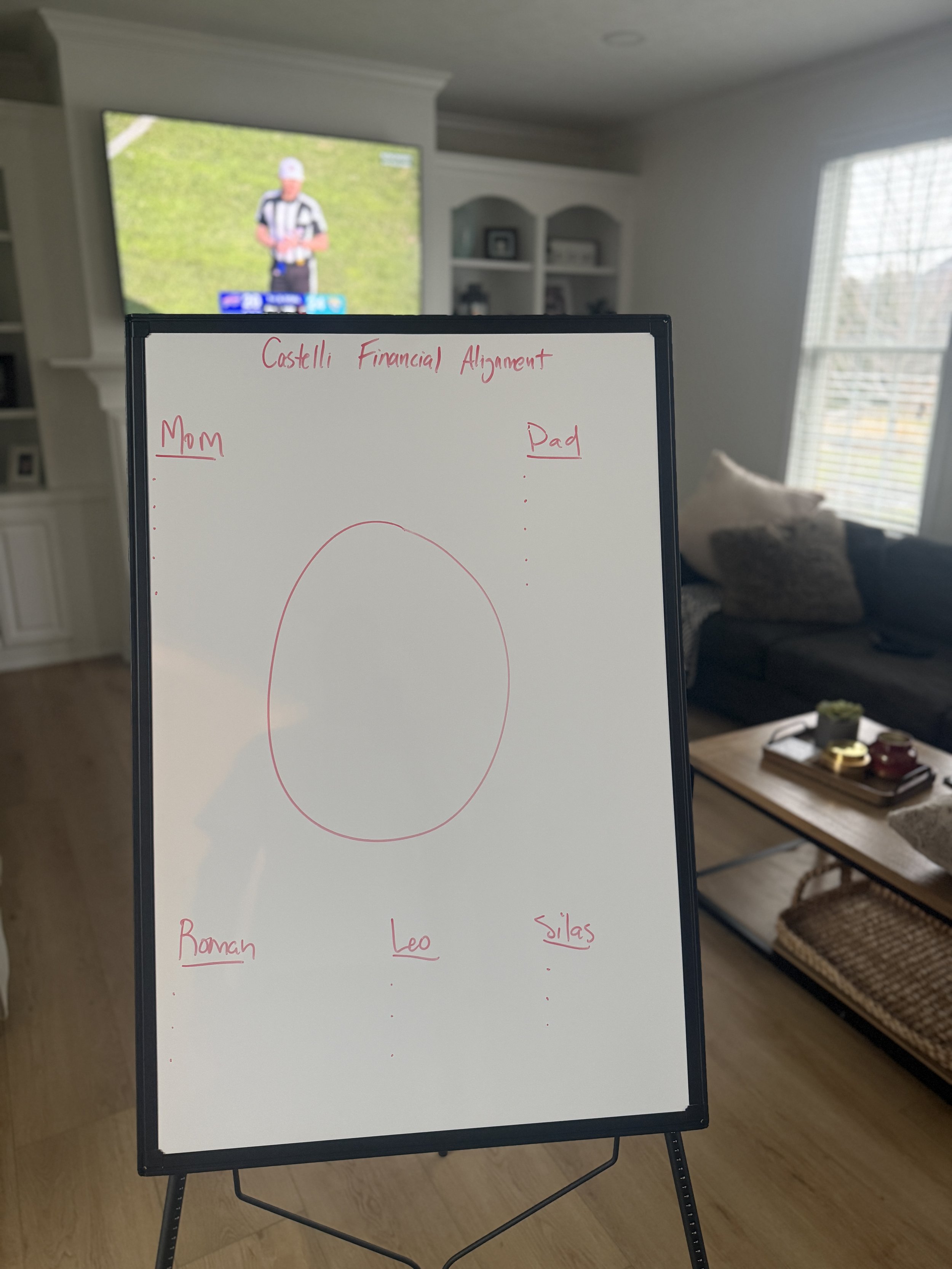
Each person spent time in individual reflection, identifying their core values. No prompts. No prescribed lists. Just an honest look at what actually matters to them and why.
Then we came together and shared—not to debate or defend, but to understand one another more clearly.
We listened. We asked questions. We noticed patterns.
Any value that appeared on three out of five lists automatically became a family value. From there, we had a conversation about which additional values from the individual lists felt important enough to carry forward together, even if not everyone resonated with them equally.
What emerged wasn’t a perfect list. It was something better: a shared map. A way of seeing one another and our collective direction more clearly.
This wasn’t about forced agreement. It was about visibility. About naming what we’re actually trying to build together instead of assuming we’re all heading in the same direction.
Only after that clarity did we bring money into the conversation.
Now that we have shared family values, we’re using budgeting software in a way most people don’t.
Not to restrict spending.
Not to optimize percentages.
Not to judge ourselves against some financial guru’s ideal.
We’re using it as a mirror.
Each quarter, we’ll review our spending—not with criticism or shame, but with curiosity. We’ll ask one simple question: How aligned was our money with what we say matters most?
Not perfectly. Not aspirationally. Honestly.
If we see alignment, we’ll acknowledge it. If we notice drift, we’ll get curious about what’s driving it.
The goal isn’t 100% alignment. That’s unrealistic, and honestly, unnecessary. Life is complex. The goal is awareness. Coherence. Reducing the gap between who you say you are and how you actually live.
When you align your money with your values, something subtle but powerful shifts. You’re no longer just managing dollars–you’re stewarding energy.
Remember: money isn’t just currency. It’s life force translated into form. Every dollar you earn represents hours of your one wild and precious life. When you spend that life force in ways that align with your deepest truth, you’re not just making a transaction—you’re making a statement. You’re telling the Universe who you are, what matters to you, and how you choose to participate in the flow of energy.
And the Universe listens. Not because you’re manifesting with perfect intention, but because alignment creates resonance. Your inner world and outer world begin to match. The friction dissolves. What you value and how you live start moving in the same direction.
From that place, money stops feeling like a problem to manage and starts feeling like a partner in your purpose.
You don’t need budgeting software or a family meeting to begin this work. You can start with one quiet question and your last month’s bank statement.
Pull it up. Not to judge it, but to observe it.
Don’t analyze every line item. Don’t shame yourself for the coffee or the impulse purchase or the subscription you forgot to cancel. Just look at the overall pattern and ask:
“What does this spending say about what I prioritize?”
“Can I see my stated values reflected here?”
“If a stranger looked at this statement, what would they assume matters most to me?”
Not “Am I perfect?” or “Do I measure up?” Just “Is there coherence between what I say matters and where my energy is actually flowing?”
Here’s what’s important to understand: the gap between your stated values and your actual spending isn’t a failure. It’s information.
It’s your life showing you where consciousness hasn’t yet caught up to intention. Where old patterns are still running. Where fear, conditioning, or inherited beliefs are still making decisions on your behalf.
That gap is sacred. Because once you see it, you can work with it.
You can ask, “What would need to shift–internally–for my spending to reflect my values more fully?”
Not just behaviors. Not tactics. What would need to shift in your consciousness? What beliefs would you need to release? What stories would you need to rewrite? What level of trust would you need to cultivate?
This is the work that most financial advice skips. It focuses on the externals—the categories, the percentages, the strategies—without ever touching the source.
But you can’t sustainably change your relationship with money from the outside in. It has to move from the inside out. Consciousness first, then money. Always.
When your values, your spending, and your energy all move in the same direction, you’re working with the current instead of against it. Less force, more flow. Less fighting, more allowing. That’s what alignment feels like. And that’s what becomes possible when you let money serve as a mirror instead of a master.
From that awareness—that honest seeing—everything else begins to shift.
Because alignment doesn’t start with restriction or perfect budgeting or elaborate systems. It starts with truth. And sometimes, the most powerful truth is simply this:
Money already knows what you value.
The question is: are you ready to know too?
Keep pursuing,
JC